POLYMETRICA Request a facility review
Polymetrica/Capability/LoRaWAN

LoRaWAN: one gateway, sensors that run for years, no cable

This is the radio layer under everything else on this site. One base station covers a facility on the European licence-free band, sensors run for years on a battery, and nothing has to be cabled or added to your corporate network.
up to 10 kmopen ground, from one gateway
yearsbattery life per sensor
EU868the European licence-free band
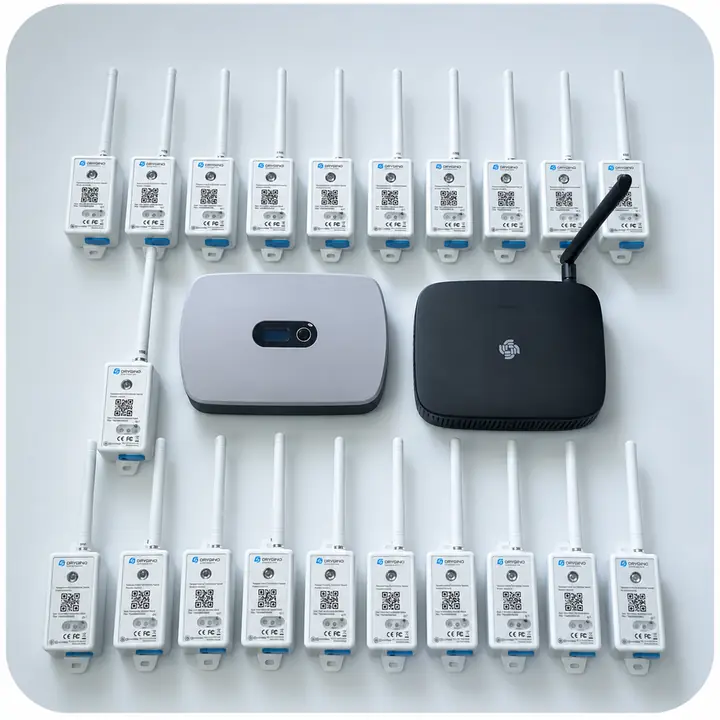
About twenty small white wireless sensors with aerials, laid out in rows around a black LoRaWAN gateway and a backup power unit.
Installed kit: LoRaWAN gateway, power supply unit and wireless sensors
What it gives you

Why the radio layer is LoRaWAN

Every monitoring system has to get readings from a sensor to a server. That choice decides what installation costs, how often somebody changes batteries, and whether your IT department has to approve anything.

One gateway per facilityA single base station covers buildings and yard, so there is no radio kit to add zone by zone.
EU868The European licence-free band. No spectrum fee, no SIM and no operator contract.
Sub-GHz through structureLower frequencies pass through walls and floors far better than 2.4 GHz does.
Battery years, not monthsSensors send small packets infrequently, so a battery lasts years rather than a season.
No cablingNothing to run through a cold room wall, across a yard or above a production line.
Independent of your networkSensors do not touch corporate WiFi, so there is nothing for IT to approve.
Points added laterA new sensor joins the existing gateway in minutes, without revisiting the design.
One backhaul, not manyThe gateway alone reaches the server over 4G, Ethernet or WiFi. The sensors never do.

LoRaWAN is a low-bandwidth technology, and that is the price of the range and the battery life. It carries readings, states and counts. It does not carry video, and it is not a control loop: when we switch equipment the command travels the same way and arrives in seconds, not milliseconds, so anything needing a hard real-time response stays on its own controller and we read it rather than replace it. The 10 km figure is open ground. Inside a steel-framed building with concrete floors it is a fraction of that, which is why coverage is surveyed rather than quoted.

The cheapest sensor is the one nobody has to cable

Coverage is worked out from your layout, not from a datasheet figure.
Request a facility review
The alternatives

What else you could do, and what it costs

The alternative
What it costs you
What LoRaWAN does instead
Cable to every point
Trays, wall penetrations, and usually a shutdown to install them
One gateway, and sensors fixed with screws
Put sensors on site WiFi
Coverage stops at the wall, and your IT department owns the problem
Its own radio, with nothing on your network
A SIM in every sensor
A contract per device and a battery measured in months
One backhaul at the gateway, batteries measured in years
A standalone data logger
It tells you afterwards, once somebody walks over and collects it
It tells you now, and keeps the record itself
Proof

Screens from live facilities

About twenty small white wireless sensors with aerials, laid out in rows around a black LoRaWAN gateway and a backup power unit.
Installed kit: gateway, power supply unit and wireless sensorsEquipment
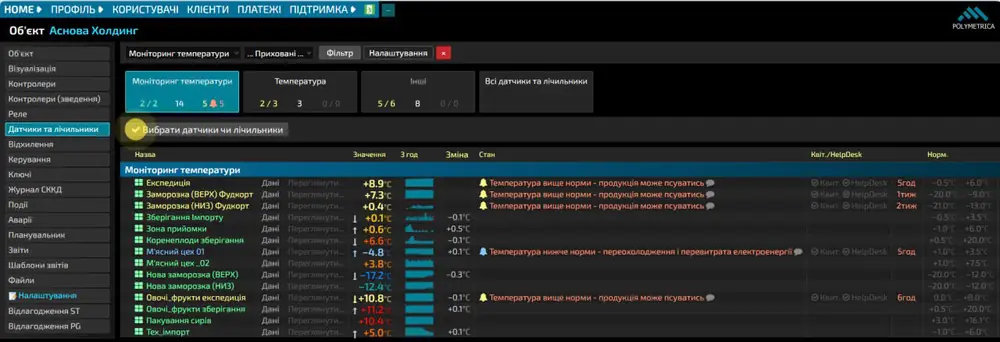
A dashboard table of monitored zones. Each row shows the current temperature, a small three-hour trend graph, the change since then, and a warning where the reading sits outside its permitted range.
Sensors and meters: value, 3-hour change, status and limit rangePlatform
Already running at
agricultural holding logistics operator national grocery chain steel pipe and railway wheel manufacturer pig farming and food production group

Deployments to date are largely in Ukraine.

Rollout

From pilot to full coverage

STEP 1

Facility review

We look at what is installed, which parameters are critical and where the losses are today.

At your facility or remote
STEP 2

Pilot on 5-10 points

A gateway, sensors and meters on the riskiest zones. Installed without stopping operations.

A few hours per facility
STEP 3

Dashboards and reports

We draw up the facility plan, set the limits for each point, the alerts and the report formats.

Shaped around your processes
STEP 4

Scaling up

The same kit across the remaining zones and facilities, with a single view for the whole company.

No new approvals needed
Next step

We will work out the coverage for your buildings

Send us a layout and the distances between buildings. We will work out how many gateways you need and where the first sensors go.

Request a facility review

Just a few lines is enough. We will prepare a preliminary estimate and an equipment list before we talk.

Name and contact are required. Everything else is optional.

Your name, then a comma, then your company. For example: Maria Santos, Acme Foods

An email address such as name@company.com. Or a phone number with the country code, starting with a plus sign, for example +44 20 7123 4567 or +49 30 1234 5678.

Where the facility is, which may not be where you are. It tells us which rules apply and who picks the enquiry up.

For example: two buildings 600 m apart, a yard, tank farm at the far end, no cabling possible

We reply within one business day. We never share your details.

If the security check does not load, or you would rather not use this form, email us at sales@polymetrica.net - it reaches the same team.